


Marketplace Regolith
Your investment opportunities


NLR ETF
NLR ETF
Uranium and Nuclear Energy ETF
Updated on 8 Apr 2026
Updated on 8 Apr 2026
About
NLR (VanEck Uranium and Nuclear ETF) is an exchange-traded fund that provides access to the entire nuclear energy value chain: from uranium mining to electricity generation at nuclear power plants.
The fund's objective is to invest in companies engaged in uranium mining, construction and maintenance of nuclear power plants, electricity generation from nuclear sources, and the supply of equipment and technologies to the nuclear industry. Unlike URA, which focuses on uranium miners, NLR covers the full industry – including major utility companies that operate nuclear power stations.
NLR was launched in August 2007 and is one of the longest-established ETFs in the nuclear sector.
Sponsor of the Trust: VanEck – an American asset management firm founded by John van Eck in 1955. VanEck manages a lineup of thematic and commodity ETFs. The current CEO is Jan van Eck.
NLR tracks the MVIS Global Uranium & Nuclear Energy Index, which includes companies that derive a significant share of revenue from nuclear and uranium activities. The index is rebalanced on a regular basis.
The fund trades on the NYSE Arca exchange and is available to investors as a standard ETF instrument.
What are you actually investing in?
When you invest in NLR, you are investing in shares of companies across the entire nuclear energy value chain – from uranium mining to electricity generation and equipment manufacturing for nuclear power plants.
NLR's returns are generated through:
- increases or decreases in the market value of company shares in the portfolio;
- the fund's dividend yield (~2.32% per year).
The investment is directly linked to the business performance of companies in the nuclear industry. Key drivers of returns include the uranium price, the pace of new reactor construction, growth in electricity demand and utility tariff regulation.
Fund composition
NLR's portfolio includes 29 companies spanning the entire nuclear energy value chain:
- Utility companies – major energy companies that operate nuclear power plants and sell electricity to consumers.
Constellation Energy (8.67%), Public Service Enterprise Group (6.18%), PG&E Corporation (5.54%), Fortum Oyj (5.01%), CEZ Group (4.39%) - Uranium miners – companies with active mines and projects at the development stage.
Cameco (7.75%), Kazatomprom (4.69%), Uranium Energy (4.42%), Energy Fuels (4.27%), NexGen Energy (4.23%), Denison Mines (4.13%), Paladin Energy (4.04%) - Nuclear tech and small modular reactors – companies developing next-generation reactors and nuclear technologies.
Oklo (3.89%), NuScale Power (3.59%), Centrus Energy (3.85%), Nano Nuclear Energy (1.36%) - Defence and engineering nuclear sector – companies manufacturing nuclear reactors for naval and industrial applications.
BWX Technologies (6.70%)
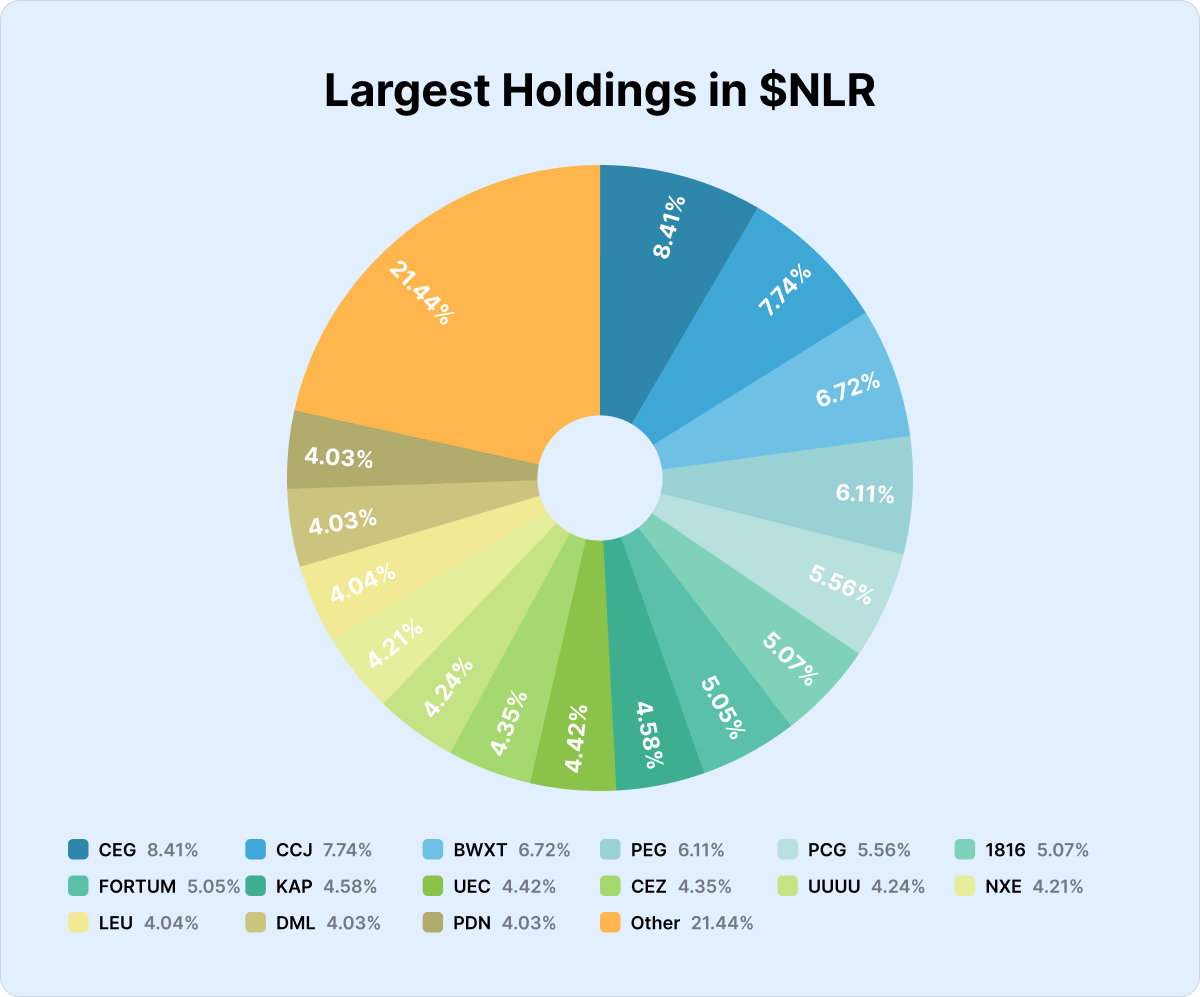
The fund's composition is reviewed in accordance with the MVIS index methodology.
How the structure works
NLR uses a standard ETF structure:
- company shares are held within the fund's custodial infrastructure through licensed custodians;
- the fund's structure is fully transparent and disclosed daily;
- the fund is overseen by US regulators and auditors.
The fund's AUM stands at approximately $4.63 billion. As an index fund, NLR follows the composition and weightings of the MVIS Global Uranium & Nuclear Energy Index.
Fees
Investor returns are generated through changes in the fund's market value. You purchase a share of NLR at the current price and realise it upon exit.
- Total Expense Ratio (TER): 0.56% per year.
When purchasing NLR through the Regolith platform, an entry fee of 2% of the transaction amount applies. Performance fee: 0%.
The role of NLR in an investment portfolio
NLR serves as a balanced tool for participating in the growth of nuclear energy, with broader coverage than purely uranium-focused ETFs. The fund can be used for the following purposes:
- Full nuclear value chain – from uranium mining to electricity generation at nuclear power plants. NLR includes both commodity companies and utilities that sell electricity to consumers.
- Lower volatility – NLR has a beta of approximately 0.92 (below market). Utility companies (Constellation Energy, PG&E) stabilise the fund compared to purely uranium-focused ETFs.
- Dividend yield – approximately 2.32% per year. Utility companies in the fund traditionally pay higher dividends.
- AI and data centers – Constellation Energy and PG&E are signing contracts to supply nuclear electricity to data centers operated by Microsoft, Google and Amazon.
- Balanced alternative to URA – while URA is an aggressive bet on uranium, NLR offers more balanced exposure to the entire nuclear industry with a defensive element through utilities.
Nuclear energy and uranium: current context
The nuclear energy sector is experiencing a renaissance. In 2025, NLR delivered a return of +56% – the best result in the fund's history. The 6-year CAGR stands at approximately 19.3%.
The key difference between NLR and purely uranium-focused funds is the presence of utility companies. Constellation Energy has become one of the fastest-growing energy companies in the world after signing a contract to supply nuclear electricity to Microsoft's data centers. PG&E and Public Service Enterprise Group are also expanding their nuclear capacity.
US electricity demand is set to hit a record in 2026 (EIA data), driven largely by AI data centers. Nuclear energy is one of the few sources of stable carbon-free generation. Dozens of new reactors are being built worldwide. The uranium deficit persists.
NLR allows investors to participate in this trend through a diversified basket of 29 companies – from raw material extraction to end-stage electricity generation.
Risks
Investing in NLR involves a number of factors typical of the nuclear and energy industry:
- Uranium price dependency – a decline in the spot uranium price affects mining companies in the portfolio.
- Regulatory risks – the nuclear industry is heavily regulated. Accidents, changes in energy policy or decisions to phase out nuclear power in individual countries could affect the entire sector.
- Tariff regulation – utility companies depend on regulatory decisions regarding electricity tariffs.
- Concentration – the top 5 positions account for approximately 35% of the fund, creating dependency on several companies.
- Growth-stage companies – Oklo, NuScale and Nano Nuclear are at the development stage and do not generate stable profits.
- Geopolitical risks – a significant share of the world's uranium reserves is concentrated in Kazakhstan and Russia.
- Long cycle – building nuclear power plants takes years, and bringing new mines to full capacity requires substantial investment and time.
As an equity instrument, the fund is subject to market fluctuations and does not guarantee positive returns. Investors may lose some or all of their investment.
Instrument parameters
- Ticker: NLR
- Type: Uranium and nuclear energy ETF
- Exchange: NYSE Arca
- Management type: Passive (index-tracking)
- Index: MVIS Global Uranium & Nuclear Energy Index
- Number of companies: 29
- AUM: approximately $4.63 billion
- Expense Ratio: 0.56%
- Beta: approximately 0.92
- Dividend yield: ~2.32% per year
- ISIN: US92189F6016
Deposit and withdrawal terms on Regolith
NLR purchases are processed on a rolling basis without a fixed date. Trades are executed 1–3 times per week.
- Minimum investment period: 1 week
- Minimum amount: $50
- Entry fee: 2%
- Performance fee: 0%
Frequently Asked Questions about NLR ETF (FAQ)
1. What is NLR?
NLR is an exchange-traded fund (ETF) that allows you to invest in 29 companies across the nuclear and uranium industry within a single purchase. Unlike purely uranium-focused funds, NLR also includes major utility companies that operate nuclear power plants and sell electricity.
2. Who manages the fund?
The fund is issued and managed by VanEck – an American asset management firm founded by John van Eck in 1955. VanEck specialises in thematic and commodity ETFs. The current CEO is Jan van Eck.
3. What exactly am I investing in when I buy NLR?
When you buy NLR, you are investing in shares of 29 companies across the entire nuclear energy value chain: uranium mining, nuclear power plant construction and maintenance, electricity generation, next-generation nuclear technologies (SMR) and the defence nuclear sector.
4. Is this an actively managed fund?
No. NLR is a passive index fund. It tracks the MVIS Global Uranium & Nuclear Energy Index. The composition is reviewed according to MVIS methodology.
5. Which companies are included in the fund?
- Utilities: Constellation Energy (8.67%), Public Service Enterprise Group (6.18%), PG&E (5.54%), Fortum (5.01%)
- Miners: Cameco (7.75%), Kazatomprom (4.69%), Uranium Energy (4.42%), Energy Fuels (4.27%)
- Nuclear tech: Oklo (3.89%), NuScale Power (3.59%), Centrus Energy (3.85%)
- Defence: BWX Technologies (6.70%)
6. Does the fund's composition change?
Yes. The composition is updated in line with the MVIS index review. Companies are added or removed based on their share of revenue from nuclear activities, market capitalisation and liquidity.
7. What are the fund's fees?
When purchasing NLR through the Regolith platform:
- entry fee: 2%
- performance fee: 0%
The fund's Expense Ratio (TER) is 0.56% per year.
8. What role does NLR play in an investment portfolio?
NLR serves as a balanced tool for participating in the growth of nuclear energy. The fund combines commodity companies (uranium) and utilities (electricity generation), which reduces volatility compared to purely uranium-focused ETFs.
9. How does NLR differ from URA?
URA focuses on uranium miners and nuclear technology companies – a more aggressive bet on uranium (beta approximately 1.40). NLR also includes utility companies (Constellation Energy, PG&E, Fortum) that operate nuclear power plants. NLR has lower volatility (beta approximately 0.92), higher dividend yield (approximately 2.32% versus approximately 0.37%) and broader industry coverage.
10. Why is nuclear energy considered a long-term trend?
Nuclear power is the only scalable source of carbon-free electricity. Electricity demand is growing at record rates due to AI data centers. Dozens of countries are building new reactors. The uranium deficit persists. Major tech companies are signing contracts for nuclear electricity supply.
11. What are the risks of investing in NLR?
The fund depends on the uranium price and the regulatory environment. Utility companies are subject to tariff regulation. Some companies are at the growth stage without stable profits. Geopolitical risks exist due to uranium reserves in Kazakhstan and Russia. Nuclear incidents could affect the entire sector.
12. Where does NLR trade?
The fund trades on NYSE Arca. The fund's AUM is approximately $4.63 billion.
13. How does the process of buying NLR through Regolith work?
Purchasing NLR through the Regolith platform is carried out on a rolling basis and is not tied to a fixed date. Trades are executed 1–3 times per week. Once an order is submitted, funds are reserved and the purchase is executed in the nearest available trading window at the actual transaction price.
14. What is the minimum investment period?
The minimum investment period is 1 week. After that, the investor may hold the position or exit the instrument without any platform-side fees.
Performance
Return for 2020
+3.53%Return for 2021
+13.64%Return for 2022
+2.30%Return for 2023
+36.61%Return for 2024
+14.25%Return for 2025
+56.47%Terms
Deal Fee
2%Carried Interest
0%Minimum investment period
1 weekRisk potential
Low