

Marketplace Regolith
Your investment opportunities


RING ETF
RING ETF
Global Gold Miners ETF
Updated on 8 Apr 2026
Updated on 8 Apr 2026
About
RING (iShares MSCI Global Gold Miners ETF) is an exchange-traded fund that provides access to the world's largest gold mining companies within a single investment.
The fund's objective is to invest in companies engaged in gold exploration, mining, processing and sales. Gold mining is a sector with a unique characteristic: when gold prices rise, miners' shares tend to rise faster due to operational leverage. This makes RING a more aggressive bet on gold compared to buying the metal itself.
RING was launched in January 2012 and is one of the leading ETFs in the Equity Precious Metals category.
Sponsor of the Trust: iShares – a division of BlackRock, the world's largest asset management company with over $11 trillion in assets under management. BlackRock was founded by Larry Fink in 1988. iShares manages a lineup of over 1,300 ETFs covering all asset classes and regions.
RING tracks the MSCI ACWI Select Gold Miners Investable Market Index, which includes companies from developed and emerging markets that derive the majority of their revenue from gold mining. The index is rebalanced on a regular basis to maintain relevance.
The fund trades on the NASDAQ exchange and is available to investors as a standard ETF instrument.
What are you actually investing in?
When you invest in RING, you are investing in shares of gold mining companies around the world. The fund tracks an index that selects companies for which gold mining is the primary source of revenue.
RING's returns are generated through:
- increases or decreases in the market value of gold mining company shares in the portfolio;
- dividends paid by companies (distributed twice a year).
The investment is directly linked to the business performance of companies engaged in gold exploration, mining, processing and sales. The key driver of returns is the global gold price.
Fund composition
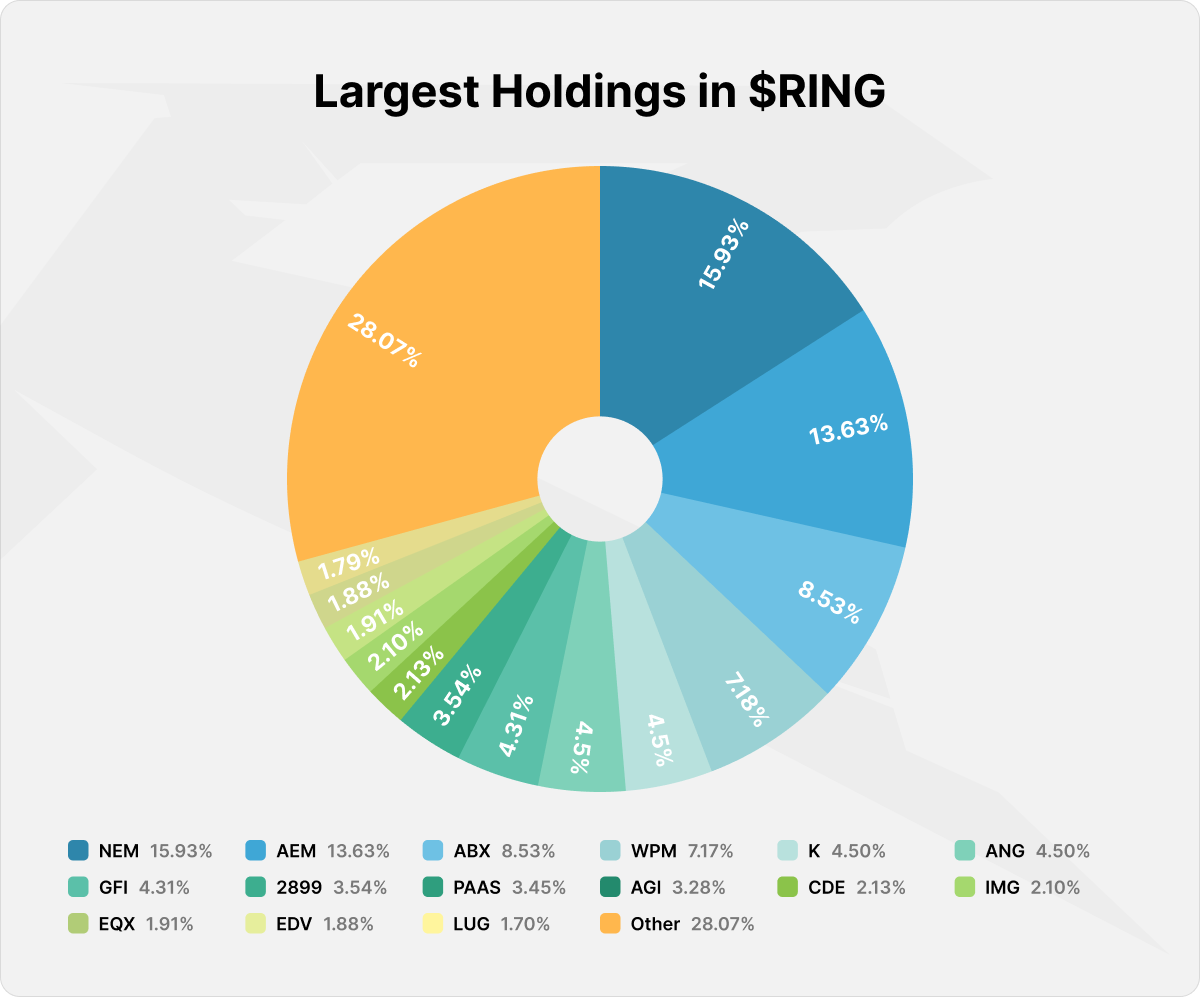
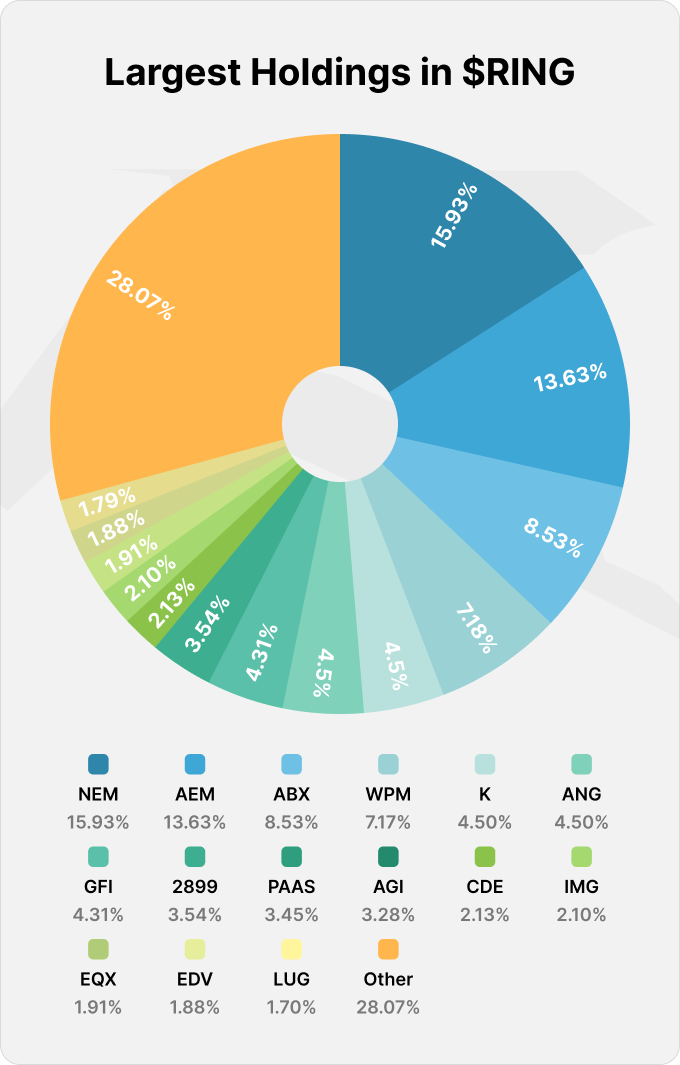
RING's portfolio includes 55 companies spanning all major gold mining regions:
- Major global miners – companies with diversified assets across multiple continents, stable revenues and established dividend policies.
Newmont (15.93%), Agnico Eagle Mines (13.63%), Barrick Mining (8.53%) - Streaming and royalty companies – companies that finance mining operations in exchange for a share of production. A business model with low operating costs and high margins.
Wheaton Precious Metals (7.17%) - Mid-tier and regional miners – companies focused on specific regions: Africa, Canada, Australia, Latin America and China.
Kinross Gold (4.50%), AngloGold Ashanti (4.50%), Gold Fields (4.31%), Zijin Mining (3.54%), Pan American Silver (3.45%), Alamos Gold (3.28%) - Growth-stage miners – companies expanding production and bringing new deposits online.
Coeur Mining (2.13%), IAMGOLD (2.10%), Equinox Gold (1.91%), Endeavour Mining (1.88%), Lundin Gold (1.70%)
The fund's composition is reviewed in accordance with MSCI's index methodology, ensuring the portfolio remains aligned with changes in the industry.
How the structure works
RING uses a standard ETF structure:
- company shares are held within the fund's custodial infrastructure through licensed custodians;
- the fund's structure is fully transparent and disclosed daily;
- the fund is overseen by US regulators and auditors.
The fund's AUM stands at approximately $3.02 billion. As an index fund, RING follows the composition and weightings of the MSCI ACWI Select Gold Miners Investable Market Index, ensuring a systematic approach to portfolio construction.
Fees and distributions
Investor returns are generated through changes in the fund's market value. You purchase a share of RING at the current price and realise it upon exit – returns are determined by the asset's price movement over the holding period.
The fund operates under the following cost structure:
- Total Expense Ratio (TER): 0.39% per year – covering fund management and administration costs. The low TER reflects passive index-based management;
- Dividend yield: ~0.83% per year.
When purchasing RING through the Regolith platform, an entry fee of 2% of the transaction amount applies. Performance fee: 0%.
The role of RING in an investment portfolio
RING serves as a tool for participating in the growth of the gold mining sector. The fund can be used for the following purposes:
- Leveraged exposure to gold – when gold prices rise by 10%, gold miners' shares can rise by 20–30% due to operational leverage. RING provides exposure to this effect.
- Protection against inflation and geopolitical risks – gold has historically served as a safe haven asset during periods of instability. Gold miners amplify this effect.
- Regional diversification – 55 companies from North America, Africa, Australia, Latin America and Asia within a single instrument.
- Alternative to physical gold – unlike gold bullion or physical gold ETFs (such as GLD), RING provides access to the business of companies rather than just the metal's price.
- Complement to GLTR – while GLTR covers a basket of four precious metals, RING focuses on companies that earn revenue from gold mining.
.png)
Current outlook: why RING deserves attention now
The gold mining sector is experiencing one of its strongest periods in recent decades. In 2025, RING delivered a return of +165% against the backdrop of record gold prices – the metal exceeded $5,500 per ounce in January 2026.
Fundamental factors support the trend. Central banks worldwide continue to build gold reserves – according to the World Gold Council, purchases in 2025 were the third-highest on record in five years. Geopolitical instability is driving demand for safe haven assets. Larry Fink, CEO of BlackRock, described gold in October 2025 as "an asset investors turn to amid mounting concerns over spiralling government debt worldwide."
J.P. Morgan forecasts a gold price of $6,300 by the end of 2026. If this materialises, gold mining companies could continue to outpace the metal itself.
RING has corrected from its January highs. For investors with a long-term horizon, current levels may present an opportunity.
Risks
Investing in RING involves a number of factors typical of the commodities sector:
- Gold price dependency – a decline in the global gold price directly impacts the revenue and profitability of gold miners. Operational leverage works both ways.
- Operational mining risks – mine accidents, environmental incidents, deposit depletion and rising extraction costs.
- Political and regulatory risks – many companies operate in jurisdictions with political instability (Africa, Latin America). Changes in taxation or asset nationalisation could affect valuations.
- Currency risks – companies operate in multiple currencies, creating additional volatility.
- Concentration – the top three holdings (Newmont, Agnico Eagle, Barrick) account for approximately 38% of the fund.
As an equity instrument, the fund is subject to market fluctuations and does not guarantee positive returns. Investors may lose some or all of their investment.
Instrument parameters
- Ticker: RING
- Type: Gold mining companies ETF
- Exchange: NASDAQ
- Management type: Passive (index-tracking)
- Index: MSCI ACWI Select Gold Miners Investable Market Index
- Number of companies: 55
- AUM: approximately $3.02 billion
- Expense Ratio: 0.39%
- Beta: 0.56
- ISIN: US46434G8556
Investor returns are generated through changes in the fund's market value.
Deposit and withdrawal terms on Regolith
RING purchases are processed on a rolling basis without a fixed date. Trades are executed 1–3 times per week depending on market conditions and the platform's operational schedule.
- Minimum investment period: 1 week
- Minimum amount: $50
- Entry fee: 2%
- Performance fee: 0%
Withdrawals are processed according to the platform's standard procedure following the completion of the minimum investment period.
Frequently Asked Questions about RING ETF (FAQ)
1. What is RING?
RING is an exchange-traded fund (ETF) that allows you to invest in 55 of the world's largest gold mining companies within a single purchase. The fund provides access to a sector that has historically served as a safe haven during periods of inflation, geopolitical instability and rising global debt.
2. Who manages the fund?
The fund is issued and managed by iShares – a division of BlackRock, the world's largest asset management company with over $11 trillion in assets under management. BlackRock was founded by Larry Fink in 1988. iShares manages a lineup of over 1,300 ETFs covering all asset classes.
3. What exactly am I investing in when I buy RING?
When you buy RING, you are investing in shares of 55 gold mining companies from different regions: North America, Africa, Australia, Latin America and Asia. This is not an investment in a single company or in physical gold – it is participation in the combined performance of the entire gold mining sector.
4. How is RING different from buying gold?
Physical gold or metal-backed ETFs provide direct exposure to the gold price. RING invests in companies that earn revenue from mining. Due to operational leverage, gold miners' shares can rise faster than the metal itself – but also fall harder. RING is a more aggressive bet on gold.
5. Is this an actively managed fund?
No. RING is a passive index fund. It tracks the MSCI ACWI Select Gold Miners Investable Market Index, which automatically selects companies that derive the majority of their revenue from gold mining. The composition is reviewed according to MSCI's methodology.
6. Which companies are included in the fund?
The fund includes companies from all key segments of gold mining:
- Major global miners: Newmont (15.93%), Agnico Eagle Mines (13.63%), Barrick Mining (8.53%)
- Streaming companies: Wheaton Precious Metals (7.17%)
- Regional miners: Kinross Gold (4.50%), AngloGold Ashanti (4.50%), Gold Fields (4.31%)
Asian miners: Zijin Mining (3.54%) - Growth-stage companies: Pan American Silver, Alamos Gold, Coeur Mining, IAMGOLD
7. Does the fund's composition change?
Yes, but less frequently than actively managed funds. The composition is updated in line with the MSCI index review – typically on a quarterly basis. Companies are added or removed based on objective criteria: share of revenue from gold mining, market capitalisation and liquidity.
8. What are the fund's fees?
When purchasing RING through the Regolith platform:
- entry fee: 2%
- performance fee: 0%
The fund's Expense Ratio (TER) is 0.39% per year – lower than actively managed funds, reflecting passive index-based management.
9. What role does RING play in an investment portfolio?
RING serves as a tool for portfolio protection and participation in the growth of the gold mining sector. The fund provides leveraged exposure to gold through miners' shares and allows investors to replace a bet on a single company with a diversified basket of 55 players from around the world.
10. Why is gold considered a safe haven asset?
Gold has historically risen during periods of inflation, geopolitical crises and currency weakness. Central banks worldwide are building gold reserves. Larry Fink, CEO of BlackRock, described gold as an asset investors turn to amid rising global government debt. J.P. Morgan forecasts a gold price of $6,300 by the end of 2026.
11. What are the risks of investing in RING?
RING has moderate volatility relative to the market (beta 0.56) but is highly dependent on the gold price. Operational leverage works both ways: when gold prices fall, miners' shares fall faster. Many companies operate in jurisdictions with political risks. The top three holdings account for approximately 38% of the fund, creating concentration. Significant short-term fluctuations are possible.
12. How does RING differ from broad index ETFs?
Broad ETFs (such as SPY) cover the entire market and include gold mining companies as only a minor share. RING provides concentrated exposure specifically to the gold mining sector, amplifying both growth potential and risk. At the same time, RING is a passive index fund with low fees.
13. How does RING differ from GLTR?
GLTR is an ETF backed by physical precious metals (gold, silver, platinum, palladium). It tracks the price of the metals themselves. RING invests in shares of companies that mine gold. When gold prices rise, RING can outpace GLTR due to operational leverage. But when gold prices fall, RING also falls harder. The two funds complement each other.
14. Where does RING trade?
The fund trades on the NASDAQ exchange in the United States. The fund's AUM is approximately $3.02 billion.
15. How does the process of buying RING through Regolith work?
Purchasing RING through the Regolith platform is carried out on a rolling basis and is not tied to a fixed date. Trades are executed 1–3 times per week depending on market conditions and the platform's operational schedule. Once an order is submitted, funds are reserved and the purchase is executed in the nearest available trading window at the actual transaction price.
16. What is the minimum investment period?
The minimum investment period is 1 week. After that, the investor may hold the position or exit the instrument without any platform-side fees.
Performance
Return for 2020
+24.98%Return for 2021
–7.49%Return for 2022
–15.40%Return for 2023
+12.34%Return for 2024
+15.99%Return for 2025
+164.75%Terms
Deal Fee
2%Carried Interest
0%Minimum investment period
1 weekRisk potential
Low