


Marketplace Regolith
Your investment opportunities


SMH ETF
SMH ETF
Semiconductor Companies ETF
Updated on 8 Apr 2026

Updated on 8 Apr 2026
About
SMH (VanEck Semiconductor ETF) is an exchange-traded fund that provides access to the world's largest semiconductor companies within a single investment.
The fund's objective is to invest in companies that design, manufacture and supply semiconductors and the equipment used to produce them. Semiconductors are the physical foundation of the entire digital economy: AI, data centers, cloud services, smartphones, automobiles and industrial automation. No modern device operates without chips.
SMH was launched in December 2011 and is the largest semiconductor ETF in the world by assets under management.
Sponsor of the Trust: VanEck – an American asset management firm founded by John van Eck in 1955. VanEck manages a lineup of thematic and commodity ETFs. The company was among the first to offer investors access to gold mining and commodity markets through ETFs. The current CEO is Jan van Eck.
SMH tracks the MVIS US Listed Semiconductor 25 Index, which includes the 25 largest semiconductor companies listed on US exchanges. The index is rebalanced on a regular basis.
The fund trades on the NASDAQ exchange and is available to investors as a standard ETF instrument.
What are you actually investing in?
When you invest in SMH, you are investing in shares of companies that build the "brains" of the digital economy – from chip design to the manufacturing equipment used to produce them.
SMH's returns are generated through:
- increases or decreases in the market value of semiconductor company shares in the portfolio;
- the fund's dividend yield (~0.30% per year).
The investment is directly linked to the business performance of companies that produce processors, graphics accelerators, memory chips, lithography equipment and other key components. Key drivers of returns include demand for AI infrastructure, cloud computing and consumer electronics.
Fund composition
SMH's portfolio includes 26 companies spanning the entire semiconductor value chain:
- Chip design and GPU – companies creating processors and accelerators for AI, data centers and consumer electronics.
NVIDIA (19.44%), Broadcom (7.85%), AMD (4.73%), Qualcomm (4.18%) - Contract manufacturing – companies producing chips on behalf of designers.
TSMC (11.51%) - Lithography and equipment – companies manufacturing the equipment used to produce chips.
ASML (5.06%), KLA (4.71%), Lam Research (4.59%), Applied Materials (4.58%) - Analogue and industrial chips – companies producing components for automotive, industrial and telecommunications applications.
Analog Devices (4.66%), Texas Instruments (4.63%) - Memory and storage – manufacturers of memory chips for servers, smartphones and data centers.
Micron (4.48%), Intel (4.37%) - Electronic design automation (EDA) – companies developing software for chip design.
Synopsys (2.55%), Cadence Design (2.48%)
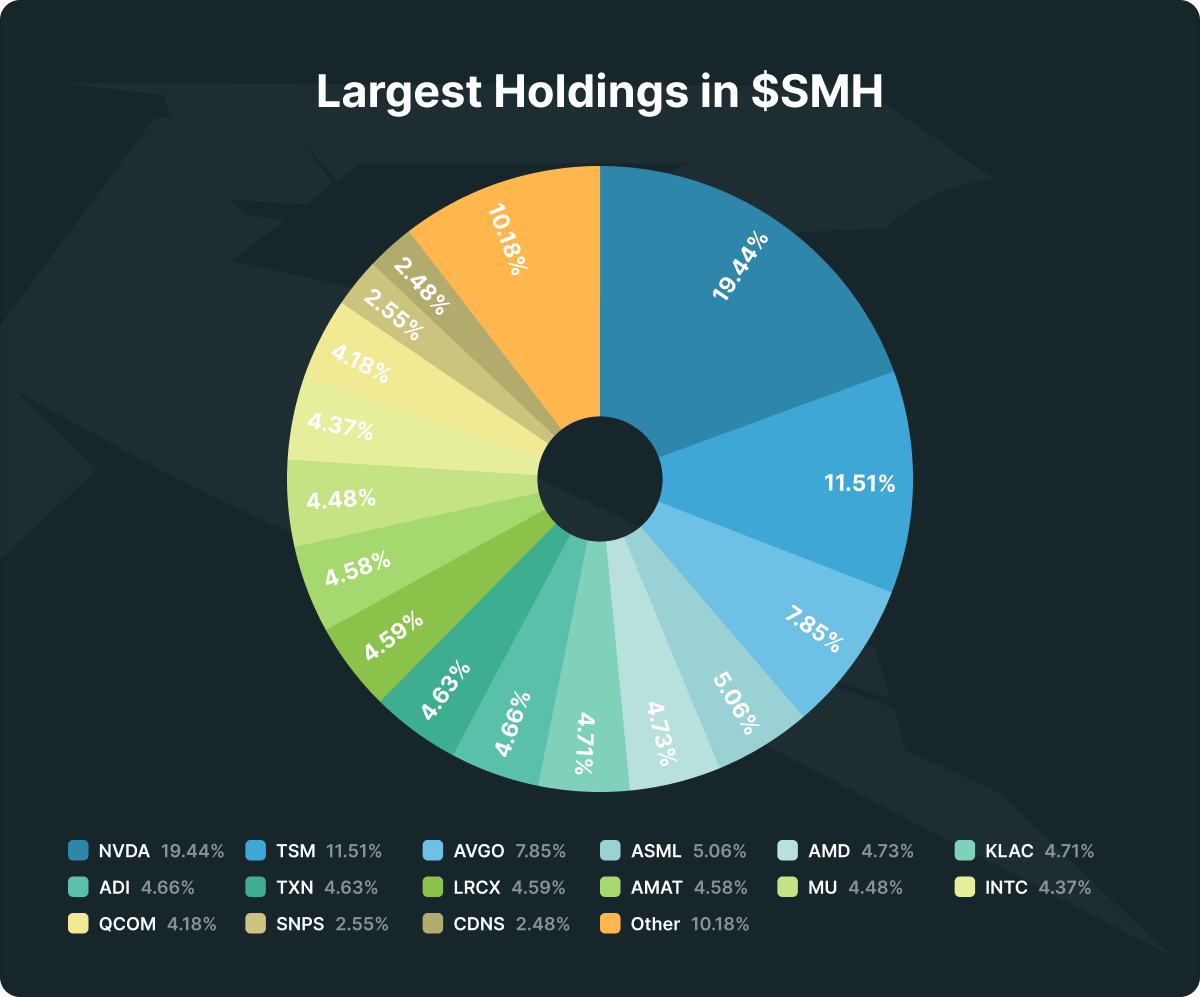
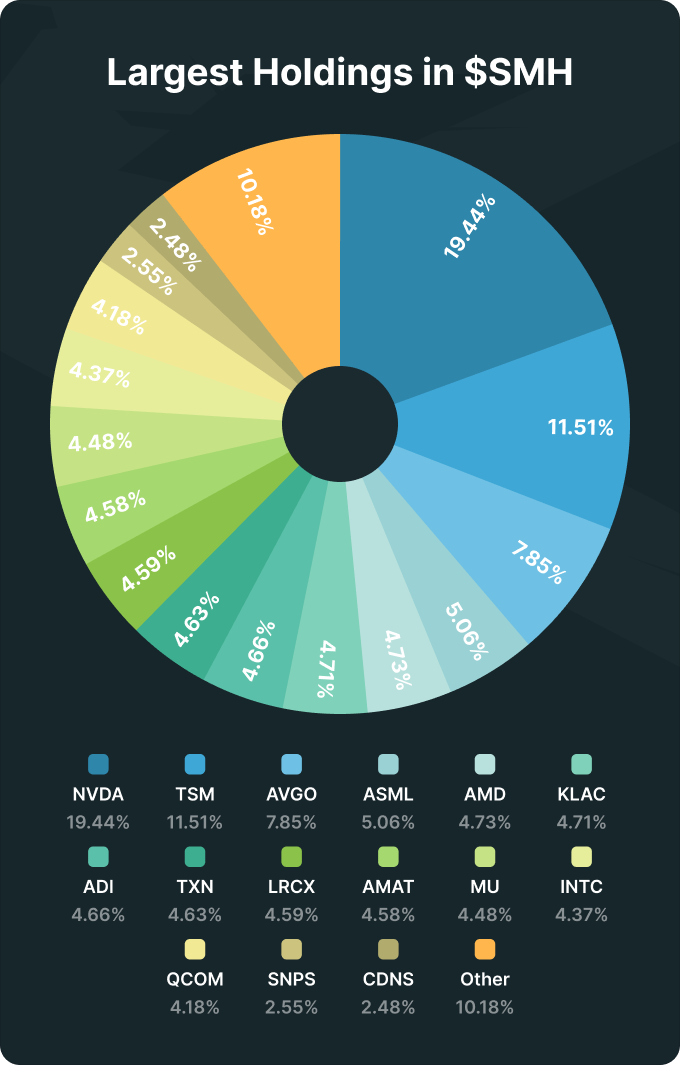
The fund's composition is reviewed in accordance with the MVIS index methodology.
How the structure works
SMH uses a standard ETF structure:
- company shares are held within the fund's custodial infrastructure through licensed custodians;
- the fund's structure is fully transparent and disclosed daily;
- the fund is overseen by US regulators and auditors.
The fund's AUM stands at approximately $40.72 billion – the largest semiconductor ETF in the world. As an index fund, SMH follows the composition and weightings of the MVIS US Listed Semiconductor 25 Index.
Fees
Investor returns are generated through changes in the fund's market value. You purchase a share of SMH at the current price and realise it upon exit.
- Total Expense Ratio (TER): 0.35% per year – one of the lowest among thematic ETFs.
When purchasing SMH through the Regolith platform, an entry fee of 2% of the transaction amount applies. Performance fee: 0%.
The role of SMH in an investment portfolio
SMH serves as a tool for participating in the growth of the semiconductor industry. The fund can be used for the following purposes:
- Exposure to AI infrastructure – every AI server, every data center, every machine learning model runs on semiconductors. SMH provides direct exposure to the companies that build this infrastructure.
- Foundation of the digital economy – semiconductors are used in cloud computing, smartphones, automobiles, medical equipment and industrial automation. Demand is growing across all segments.
- Concentrated exposure – 26 of the sector's largest companies. No small-cap or speculative positions – only market leaders.
- Alternative to individual stocks – instead of betting on NVIDIA or TSMC alone, the investor gains a basket of all key players across the value chain: from design to manufacturing and equipment.
- Complement to broad tech ETFs – while AIQ or BOTZ cover the technology sector broadly, SMH focuses on the hardware foundation without which AI and cloud are impossible.
The semiconductor sector: current context
The semiconductor industry is at the centre of the global technology transformation. Over the past six years, SMH has delivered an annualised return of approximately 29.7% – one of the strongest among all sector ETFs.
Key growth drivers remain in place. Spending on AI infrastructure is growing exponentially: Microsoft, Google, Amazon and Meta are increasing capital expenditure on data centers every year. NVIDIA remains the dominant supplier of GPUs for AI model training. TSMC is expanding production capacity, including new fabrication plants in the US and Japan.
Semiconductors also play a key role in the automotive industry: every electric vehicle contains 3–5 times more chips than a combustion engine car. The rise of autonomous driving is creating additional demand.
For investors with a long-term horizon, the current level may present an opportunity.
Risks
Investing in SMH involves a number of factors typical of the technology sector:
- High volatility – SMH has a beta of 1.56, meaning significant swings relative to the broader market. Semiconductors are one of the most volatile sectors.
- Cyclicality – the semiconductor industry is subject to supply and demand cycles. Chip overproduction can lead to declining prices and margins.
- Concentration – NVIDIA and TSMC together account for approximately 31% of the fund. The results of two companies determine the performance of the entire ETF.
- Geopolitical risks – TSMC is located in Taiwan. An escalation of tensions in the Taiwan Strait could impact the entire semiconductor supply chain.
- High valuation – the fund's P/E ratio stands at 43.45, reflecting elevated market expectations. Any slowdown in AI investment could lead to a revaluation.
- Trade restrictions – export controls on chips and equipment (particularly to China) could affect company revenues.
As an equity instrument, the fund is subject to market fluctuations and does not guarantee positive returns. Investors may lose some or all of their investment.
Instrument parameters
- Ticker: SMH
- Type: Semiconductor companies ETF
- Exchange: NASDAQ
- Management type: Passive (index-tracking)
- Index: MVIS US Listed Semiconductor 25 Index
- Number of companies: 26
- AUM: approximately $40.72 billion
- Expense Ratio: 0.35%
- Beta: 1.56
- Dividend yield: ~0.30% per year
- ISIN: US92189F6768
Deposit and withdrawal terms on Regolith
SMH purchases are processed on a rolling basis without a fixed date. Trades are executed 1–3 times per week.
- Minimum investment period: 1 week
- Minimum amount: $50
- Entry fee: 2%
- Performance fee: 0%
Frequently Asked Questions about SMH ETF (FAQ)
1. What is SMH?
SMH is an exchange-traded fund (ETF) that allows you to invest in the 26 largest semiconductor companies in the world within a single purchase. The fund provides access to the sector that forms the physical foundation of AI, cloud computing and the entire digital economy.
2. Who manages the fund?
The fund is issued and managed by VanEck – an American asset management firm founded by John van Eck in 1955. VanEck specialises in thematic and commodity ETFs and manages one of the largest lineups of sector-specific funds in the world.
3. What exactly am I investing in when I buy SMH?
When you buy SMH, you are investing in shares of the 26 largest semiconductor companies: from chip designers (NVIDIA, AMD) to manufacturers (TSMC) and equipment suppliers (ASML, Applied Materials). This is participation in the combined performance of the entire semiconductor value chain.
4. Is this an actively managed fund?
No. SMH is a passive index fund. It tracks the MVIS US Listed Semiconductor 25 Index. The composition is reviewed according to MVIS methodology.
5. Which companies are included in the fund?
- Chip design: NVIDIA (19.44%), Broadcom (7.85%), AMD (4.73%), Qualcomm (4.18%)
- Manufacturing: TSMC (11.51%)
- Equipment: ASML (5.06%), KLA (4.71%), Lam Research (4.59%), Applied Materials (4.58%)
- Analogue chips: Analog Devices (4.66%), Texas Instruments (4.63%)
- Memory: Micron (4.48%), Intel (4.37%)
- EDA: Synopsys (2.55%), Cadence Design (2.48%)
6. Does the fund's composition change?
Yes. The composition is updated in line with the MVIS index review. Companies are added or removed based on market capitalisation, liquidity and sector classification.
7. What are the fund's fees?
When purchasing SMH through the Regolith platform:
- entry fee: 2%
- performance fee: 0%
The fund's Expense Ratio (TER) is 0.35% per year – one of the lowest among thematic ETFs.
8. What role does SMH play in an investment portfolio?
SMH serves as a tool for direct participation in the growth of the semiconductor industry. The fund provides concentrated exposure to the hardware foundation of AI and the digital economy, allowing investors to replace a bet on a single company with a diversified basket of 26 sector leaders.
9. Why are semiconductors considered a long-term trend?
Semiconductors are the physical foundation of every digital device. Demand is growing on the back of the AI boom, cloud computing expansion, vehicle electrification and industrial automation. Every new AI server, every electric vehicle and every data center increases the need for chips.
10. How does SMH differ from SOXX?
Both ETFs invest in semiconductor companies. SMH includes 26 companies and has an AUM of $40.7 billion – the largest in the sector. SOXX includes 34 companies and has an AUM of $20.3 billion. SMH is more concentrated, with a larger weighting in NVIDIA and TSMC. SOXX is more diversified.
11. What are the risks of investing in SMH?
SMH has high volatility (beta 1.56). Semiconductors are subject to supply and demand cycles. NVIDIA and TSMC together account for approximately 31% of the fund – high concentration. TSMC is located in Taiwan, creating geopolitical risk. The fund's P/E of 43.45 reflects high expectations dependent on continued AI investment. Export controls on chips could affect company revenues.
12. Where does SMH trade?
The fund trades on NASDAQ. The fund's AUM is approximately $40.72 billion – the largest semiconductor ETF in the world.
13. How does the process of buying SMH through Regolith work?
Purchasing SMH through the Regolith platform is carried out on a rolling basis and is not tied to a fixed date. Trades are executed 1–3 times per week. Once an order is submitted, funds are reserved and the purchase is executed in the nearest available trading window at the actual transaction price.
14. What is the minimum investment period?
The minimum investment period is 1 week. After that, the investor may hold the position or exit the instrument without any platform-side fees.
Performance
Return for 2020
+55.54%Return for 2021
+42.14%Return for 2022
–33.52%Return for 2023
+73.37%Return for 2024
+39.08%Return for 2025
+49.17%Terms
Deal Fee
2%Carried Interest
0%Minimum investment period
1 weekRisk potential
Low