


Marketplace Regolith
Your investment opportunities


VDE ETF

Updated on 8 Apr 2026
About
VDE (Vanguard Energy ETF) is an exchange-traded fund that provides exposure to the US energy sector: oil and gas corporations, exploration and production, refining, pipeline infrastructure, and oilfield services.
The fund's objective is to provide access to companies that form the energy backbone of the world's largest economy. This is the sector that extracts, refines, and transports oil and gas – resources no economy can function without.
VDE was launched in September 2004 and is one of the longest-running energy ETFs from Vanguard.
Sponsor of the Trust: Vanguard – one of the world's largest asset managers with over $9 trillion in assets under management. Vanguard was founded by John Bogle in 1975 and is widely recognized as a pioneer of index-based portfolio management. The company is owned by its funds (and, by extension, its shareholders), making its structure unique in the market.
VDE tracks the MSCI US Investable Market Energy 25/50 Index, which includes large-, mid-, and small-cap US energy companies. The index is reviewed on a regular basis.
The fund is listed on NYSE Arca and is accessible as a standard ETF instrument.
What are you actually allocating to?
By purchasing VDE, you gain exposure to shares of 112 US energy companies – from the world's largest oil and gas corporations to companies that service fields, refine crude, and operate pipelines.
VDE performance is driven by:
- appreciation or decline in the market value of portfolio companies;
- the fund's dividend yield (~2.47% per year).
Your position is directly tied to the business results of companies that extract, refine, and transport hydrocarbons. Key performance drivers include oil and gas prices, production volumes, global energy demand, and the geopolitical environment.
Fund composition
The VDE portfolio includes 112 companies spanning all energy subsectors:
- Major oil and gas corporations – vertically integrated companies operating across the full chain: from exploration to end-product sales.
Exxon Mobil (22.42%), Chevron (14.86%) - Exploration and production – companies specializing in finding and extracting oil and gas.
ConocoPhillips (5.76%), EOG Resources (2.85%) - Midstream / pipelines – operators of pipeline infrastructure for transporting and storing hydrocarbons.
Williams Companies (3.82%), Kinder Morgan (2.80%) - Oilfield services – companies servicing fields: drilling, diagnostics, equipment.
SLB (2.85%), Baker Hughes (2.71%) - Refining – companies that process crude oil into gasoline, diesel, and other products.
Valero Energy (2.67%), Phillips 66 (2.62%)
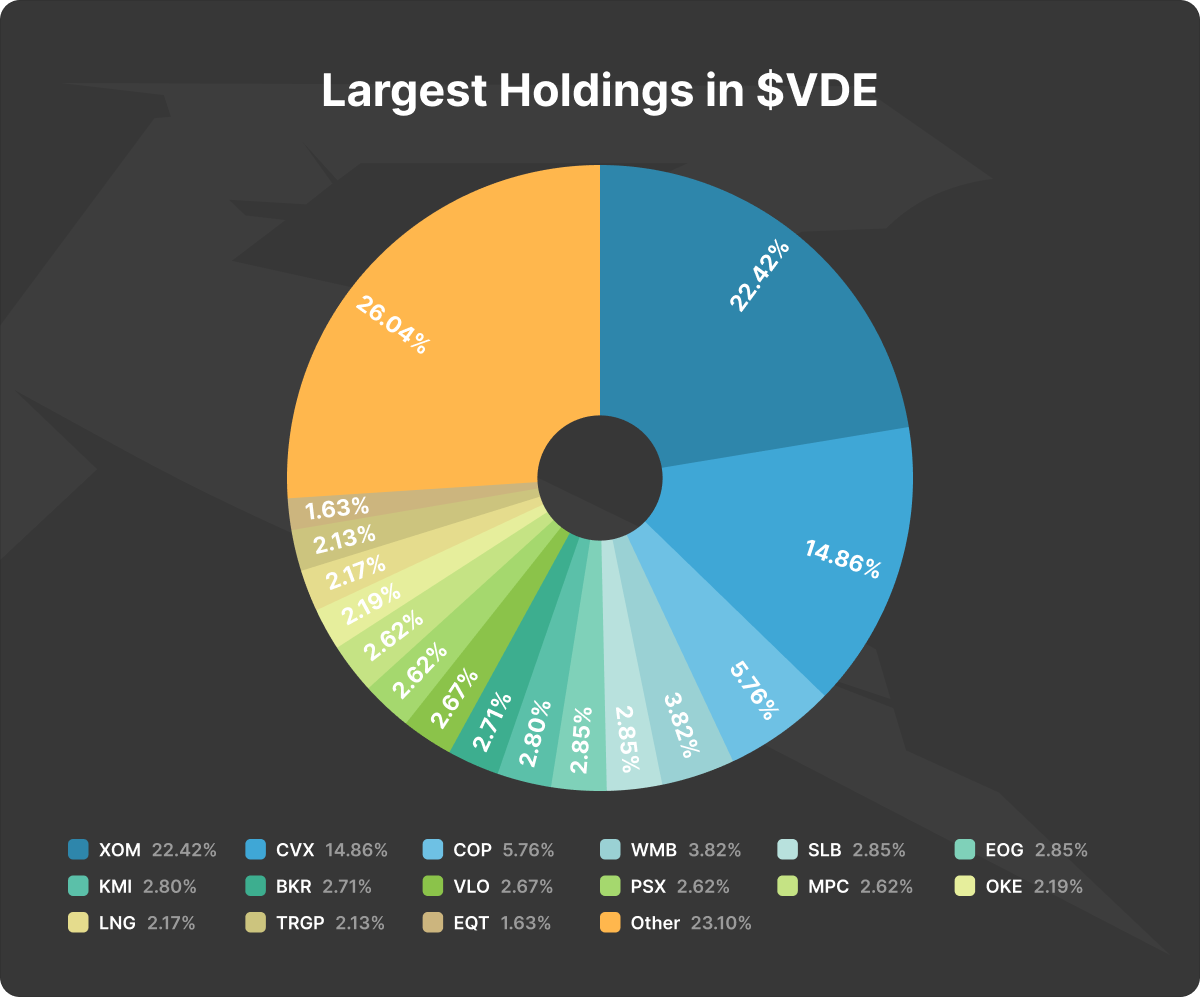
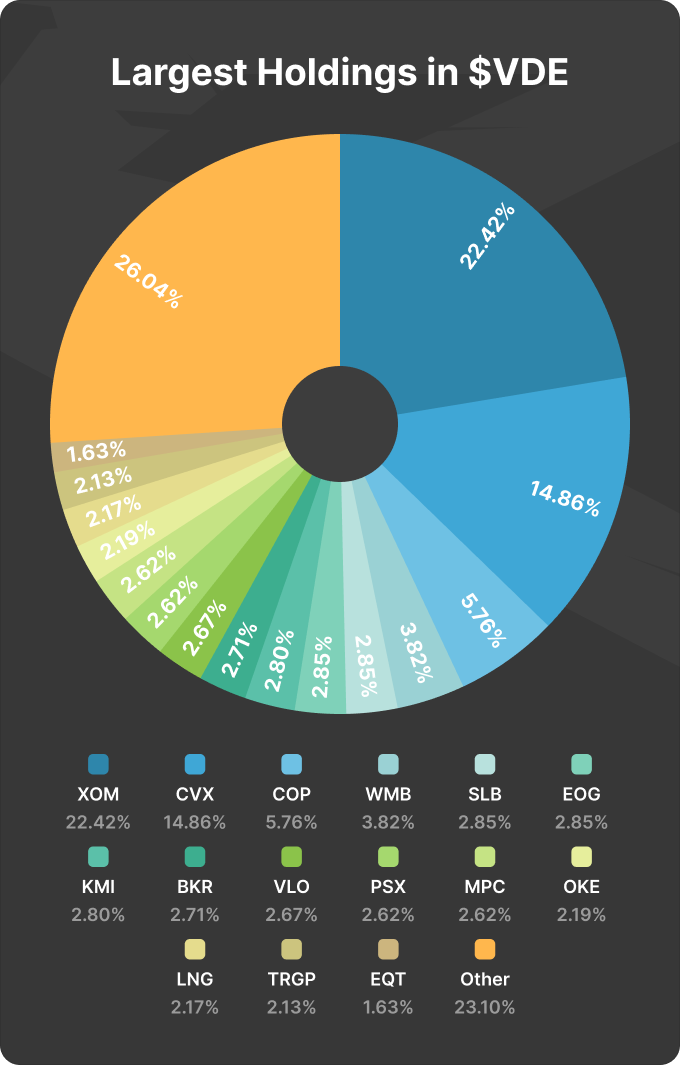
The fund composition is reviewed in accordance with the MSCI index methodology.
How the structure works
VDE uses a standard ETF structure:
- company shares are held within the fund's custodial infrastructure through State Street Bank & Trust;
- the fund structure is fully transparent and disclosed on a daily basis;
- the fund is overseen by US regulators and auditors.
The fund's AUM is approximately $11.03 billion. As an index fund, VDE follows the composition and weightings of the MSCI US Investable Market Energy 25/50 Index.
Fees
Returns are driven by changes in the fund's market value. You acquire a share in VDE at the current price and realize the value upon exit.
- Total Expense Ratio (TER): 0.09% per year – one of the lowest fees among energy ETFs on the market.
When purchasing VDE through the Regolith platform, a 2% entry fee applies. Performance fee: 0%.
The role of VDE in a portfolio
VDE serves as a tool for gaining exposure to the growth of the US energy sector. The fund can be used for the following purposes:
- A position in hydrocarbon energy – oil and gas account for over 50% of global energy consumption. Even under energy transition scenarios, demand for hydrocarbons will persist for decades.
- Dividend income – the energy sector historically pays some of the highest dividends on the market (~2.47% annually for VDE). The largest companies return capital to shareholders through dividends and buybacks.
- Inflation hedge – rising oil and gas prices often coincide with inflationary periods. Energy companies directly benefit from higher commodity prices.
- Geopolitical premium – conflicts and supply disruptions drive energy prices higher. The current situation (Middle East tensions, pressure on the Strait of Hormuz) underscores the strategic importance of the sector.
- Low fees – a TER of 0.09% means nearly all returns stay with the holder.
US energy sector: current context
The energy sector remains one of the key beneficiaries of the current geopolitical environment. Over the past five years, VDE has delivered an average annual return of ~22.9% (CAGR). In 2022, the fund gained 62.86% – its best result in the past decade, driven by Europe's energy crisis and rising oil prices.
The current geopolitical environment strengthens the sector's position. Middle East tensions and risks to transit through the Strait of Hormuz have pushed Brent crude above $107 per barrel. Supply disruptions are estimated at 4.5–5 million barrels per day – one of the largest in the history of the oil market.

Exxon Mobil and Chevron are reporting record cash flows and directing tens of billions toward buybacks and dividends. ConocoPhillips is ramping up production in the Permian Basin. Williams Companies and Kinder Morgan are benefiting from growing US LNG exports.
Despite the long-term energy transition trend, global oil consumption continues to rise and is set to reach a new record in 2026 (IEA data). VDE provides access to this cycle through a diversified basket of 112 companies – from extraction to end-stage refining.
Risks
Holding VDE involves a number of factors typical of the energy sector:
- Dependence on oil and gas prices – this is the primary driver of returns. Falling prices directly reduce revenue and earnings for companies in the fund.
- High concentration – Exxon Mobil and Chevron make up over 37% of the fund. The performance of two companies determines a significant share of the fund's trajectory.
- Energy transition – the long-term growth of renewables may reduce demand for hydrocarbons and reshape the market.
- Regulatory risks – tighter environmental legislation, carbon taxes, and drilling restrictions may increase costs.
- Geopolitical risks – sanctions, conflicts, and trade restrictions affect supply chains and production volumes.
- Cyclicality – the energy sector is sensitive to economic cycles. During recessions, demand for energy declines (VDE lost 33% in 2020).
As an equity instrument, the fund is subject to market fluctuations and does not guarantee a positive outcome. You may lose part or all of your allocated capital.
Instrument parameters
- Ticker: VDE
- Type: US energy sector ETF
- Exchange: NYSE Arca
- Management type: Passive (index-tracking)
- Index: MSCI US Investable Market Energy 25/50 Index
- Number of companies: 112
- AUM: ~$11.03 billion
- Expense ratio: 0.09%
- Beta: ~0.73
- P/E: ~18.97
- Dividend yield: ~2.47% per year
- ISIN: US92204A3068
Deposit and withdrawal details via Regolith
VDE purchases are executed on a rolling basis without a fixed date. Transactions are processed 1–3 times per week.
- Minimum holding period – 1 week
- Minimum amount – $50
- Entry fee – 2%
- Performance fee – 0%
Frequently Asked Questions about VDE ETF (FAQ)
1. What is VDE?
VDE is an exchange-traded fund (ETF) that provides exposure to 112 US energy companies in a single purchase. The fund covers major oil and gas corporations, exploration and production companies, refining, pipeline infrastructure, and oilfield services.
2. Who manages the fund?
The fund is issued and managed by Vanguard – one of the world's largest asset managers with over $9 trillion in assets. Vanguard was founded by John Bogle in 1975 and pioneered index-based portfolio management.
3. What exactly am I buying when I purchase VDE?
By purchasing VDE, you gain exposure to 112 US energy companies: oil and gas giants (Exxon Mobil, Chevron), exploration and production (ConocoPhillips, EOG Resources), pipelines (Williams Companies, Kinder Morgan), refining (Valero Energy, Phillips 66), oilfield services (SLB, Baker Hughes).
4. Is this an actively managed fund?
No. VDE is a passive index fund. It tracks the MSCI US Investable Market Energy 25/50 Index. The composition is reviewed according to MSCI methodology.
5. What companies are included in the fund?
- Major oil and gas corporations: Exxon Mobil (22.42%), Chevron (14.86%)
- Exploration and production: ConocoPhillips (5.76%), EOG Resources (2.85%)
- Midstream / pipelines: Williams Companies (3.82%), Kinder Morgan (2.80%)
- Oilfield services: SLB (2.85%), Baker Hughes (2.71%)
- Refining: Valero Energy (2.67%), Phillips 66 (2.62%)
6. Does the fund composition change?
Yes. The composition is updated in line with MSCI index reviews. Companies are added or removed based on market capitalization, liquidity, and energy sector classification.
7. What are the fees?
When purchasing VDE through the Regolith platform:
- Entry fee – 2%
- Performance fee – 0%
The fund's expense ratio (TER) is 0.09% per year – one of the lowest among energy ETFs on the market.
8. What role does VDE play in a portfolio?
VDE serves as a tool for gaining exposure to the growth of the US energy sector. The fund provides access to companies that extract, refine, and transport oil and gas. The energy sector pays high dividends (~2.47%) and acts as a natural hedge against inflation.
9. How is VDE different from URA?
URA focuses on the uranium and nuclear industry – uranium miners, reactor developers, and nuclear technology companies. VDE covers oil and gas: extraction, refining, and transportation of hydrocarbons. URA is more volatile (beta ~1.40 vs. 0.73 for VDE). Both funds are about energy, but different parts of it.
10. Why is the energy sector considered resilient?
Oil and gas account for over 50% of global energy consumption. Even under energy transition scenarios, demand for hydrocarbons will persist for decades. The sector's largest companies generate stable cash flow and return capital to shareholders through dividends and buybacks.
11. What are the risks?
Oil and gas prices are the primary driver of returns. High concentration: Exxon Mobil and Chevron make up over 37% of the fund. The energy transition may reduce long-term demand. Regulatory and geopolitical risks affect supply chains. The sector is sensitive to economic cycles.
12. Where is VDE traded?
The fund is listed on NYSE Arca. The fund's AUM is approximately $11.03 billion.
13. How does buying VDE through Regolith work?
Purchasing VDE through the Regolith platform is done on a rolling basis without a fixed date. Transactions are processed 1–3 times per week. Once an order is placed, the funds are reserved, and the purchase is completed in the nearest available trading window at the actual transaction price.
14. What is the minimum holding period?
The minimum holding period is 1 week. After that, you can maintain your position or exit the instrument with no platform-side fees.
Performance
Return for 2020
–33.06%Return for 2021
+56.21%Return for 2022
+62.86%Return for 2023
+0.00%Return for 2024
+6.75%Return for 2025
+7.07%Terms
Deal Fee
2%Carried Interest
0%Minimum investment period
1 weekRisk potential
Low